Family Heirloom Blanket (ca.1980 - ca.1990)

Exhibitions Featuring This Artwork

Events connected to this artwork
Guestbook
Description
Believed to have been created by Lola Maring
Family Heirloom Blanket
1980s to early 1990s
handwoven cotton or polyester
Courtesy of the artist
This blanket is the only tangible memory I have of my great aunt, Lola Maring (Maria Acosta Padilla). She was an older sister of my paternal grandmother, Lola Susana, and the last known practicing weaver in our family. When my Papa was a young boy growing up in Bangar, La Union, one of the major weaving towns in the Philippines, he shared with me that the women in our family made a livelihood from weaving and farming. During his afternoon naps, he recalls falling asleep to the rhythmic sounds of the looms echoing through the house. Since the weaving pattern in this blanket is similar to handwoven American coverlets, I also reflect on how American colonization in the Philippines (1898-1946) continued to influence Filipino weaving practices decades after the country regained their independence. —Carol Ann Apilado
Metadata
Claims
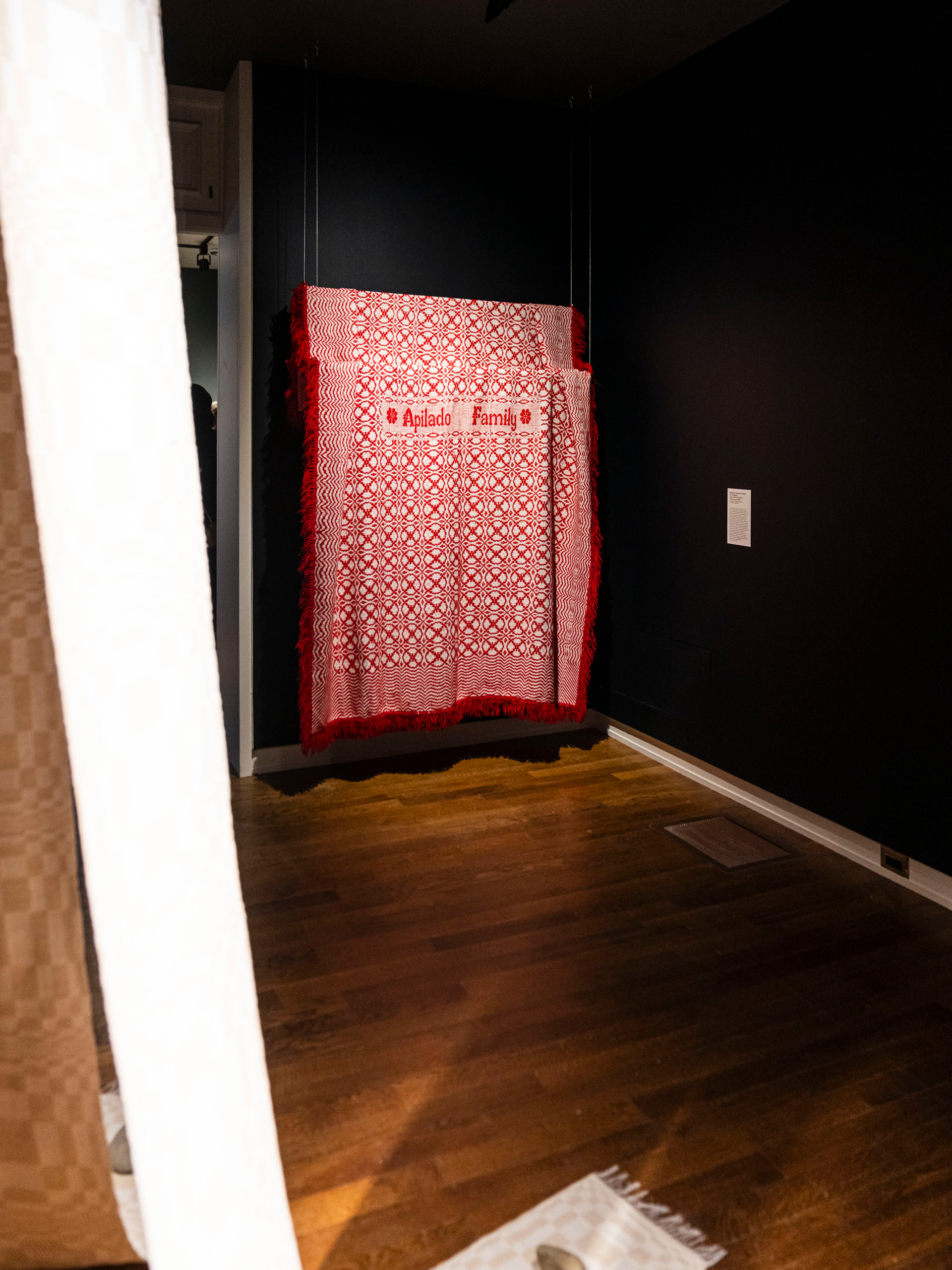

Family Heirloom Blanket (ca.1980 - ca.1990)
Description
Believed to have been created by Lola Maring
Family Heirloom Blanket
1980s to early 1990s
handwoven cotton or polyester
Courtesy of the artist
This blanket is the only tangible memory I have of my great aunt, Lola Maring (Maria Acosta Padilla). She was an older sister of my paternal grandmother, Lola Susana, and the last known practicing weaver in our family. When my Papa was a young boy growing up in Bangar, La Union, one of the major weaving towns in the Philippines, he shared with me that the women in our family made a livelihood from weaving and farming. During his afternoon naps, he recalls falling asleep to the rhythmic sounds of the looms echoing through the house. Since the weaving pattern in this blanket is similar to handwoven American coverlets, I also reflect on how American colonization in the Philippines (1898-1946) continued to influence Filipino weaving practices decades after the country regained their independence. —Carol Ann Apilado
Exhibitions Featuring This Artwork
Events connected to this artwork
Guestbook
Metadata
Claims

Editing is restricted
You cannot submit an edit because the artist who produced this artwork has been claimed by .
Editing this section requires claiming the profile of the artist who produced this work.
Claims are one of the many safeguards in place on UntitledDb that preserve the integrity of the information on our platform.
Editing is restricted
Editing this section requires claiming the profile of the artist who produced this work.
Claims are one of the many safeguards in place on UntitledDb that preserve the integrity of the information on our platform.
Editing is restricted
A reputation of 20,000 or higher is needed to edit posts created by other users.
Familiarize yourself with our platform by creating new posts and watching your favorites. You'll reach a reputation of 20,000 in no time.
This is one of the many safeguards in place on UntitledDb that preserve the integrity of the information on our platform.
Account access options
Log in and connect with the art world
By continuing, you agree to our Terms of Use and Privacy Policy.
or
Account access options
Sign up and connect with the art world
By continuing, you agree to our Terms of Use and Privacy Policy.
or
Account access options
Expand your reach with UntitledDb Pro
By continuing, you agree to our Terms of Use and Privacy Policy.
or
Account access options
Grow your institution's reach and impact with UntitledDb Enterprise
By continuing, you agree to our Terms of Use and Privacy Policy.
or
Sign up for UntitledDb Pro to unlock this feature